Admissions email, where every applicant thinks they are the only one
An admissions office receives the same forty questions several thousand times, in bursts around deadlines, from people for whom the answer matters enormously. The information exists, usually on a webpage the applicant did not find, and the office answers by hand until the deadline passes.
4 min read
What is safely answerable
Entry requirements, deadlines, what documents are needed, how to submit them, fee levels, accommodation basics, visa documentation processes, and the status of an application from your student system.
That last one is the highest-volume item in most admissions inboxes and the easiest to get right: "we received your transcript on 3 August, your reference is still outstanding" is a factual answer from a record, and it prevents the three follow-up emails that silence generates.
What must never be automated
| Request | Why |
|---|---|
| Any decision, or a hint about one | Decisions are made by people, on process |
| Whether a specific applicant is likely to get in | Encouragement is heard as a promise |
| Assessment of qualifications for equivalence | Judgement with consequences |
| Fee waivers, hardship, and scholarships | Money and circumstance |
| Anything about disability provision | Record, acknowledge, and route |
| Appeals and complaints | Formal process |
| Anything suggesting distress | A person, immediately |
The second row deserves the most care. An applicant asking "do you think I have a chance with these grades" is asking for reassurance, and any warmth the agent offers will be remembered as a commitment. The correct answer states the published requirements and stops.
The safeguarding line
Admissions inboxes receive messages from young people, occasionally in distress, sometimes disclosing something serious. This is not an edge case to handle later.
Two rules, both structural. Anything that reads as distress, safeguarding, or a disclosure escalates immediately to a named human with a defined route, and the agent's reply is a short acknowledgement that a person is coming rather than an attempt to help.
That escalation must go somewhere staffed, including during the periods when the office is closed and applicants are most likely to write. If your out-of-hours path is nobody, then the agent's answer for that category needs to say so honestly and point to a service that is available, rather than implying someone is reading.

Deadlines change the operational shape
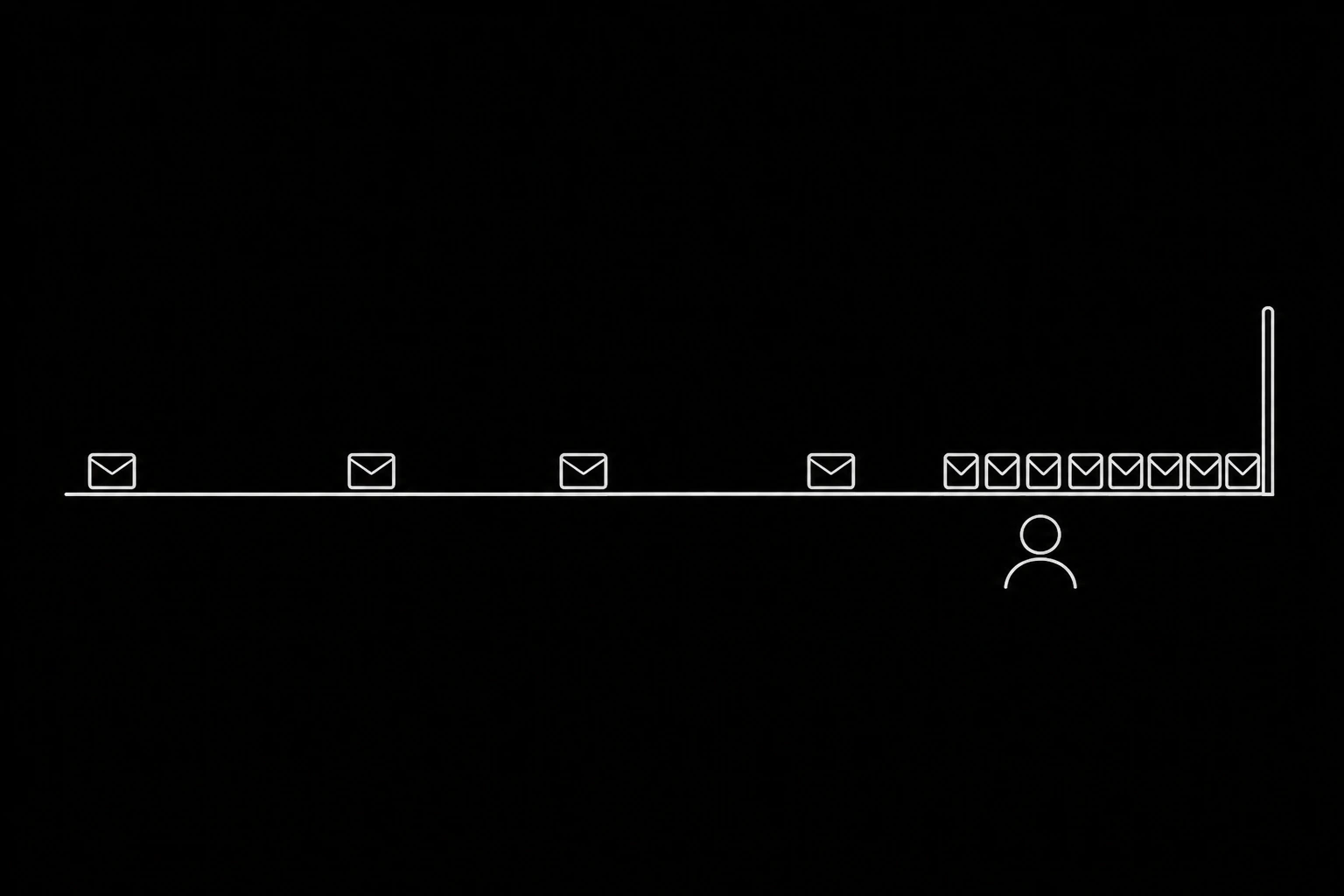
Volume around a deadline is not gradual. It multiplies in the final 48 hours, exactly when the answers matter most and the office is least able to keep up, which makes this one of the strongest cases for an agent and one of the most demanding.
The mechanics matter: per-thread serialisation, deduplication, and a concurrency cap so a spike becomes a queue rather than a wall of refusals, per what happens when forty messages arrive at once. And the answer for "my document upload is failing an hour before the deadline" must be a fast route to a person, because that is a case where minutes matter to someone's year.
Data, and the age of the people involved
Applicant data is personal data, some applicants are minors, and education has its own layer of expectations on top of the general obligations. Practically: record facts rather than impressions, keep what the process needs and no more, decide retention deliberately rather than keeping everything until someone asks, and know what leaves your systems when the agent reads a message, per where the mail actually goes and sending the model less than you think it needs.
Nothing evaluative about an applicant should ever be written by an agent. It is a record, subject to access requests, and it is not the agent's judgement to make.
Beyond admissions
The same shape works for the rest of student-facing administration: enrolment questions, timetable and module queries, fee payment logistics, and graduation arrangements. All high volume, all documented, all currently answered one at a time.
The line stays where it was: administration is safe, assessment is not, and anything about a student's wellbeing goes to a person immediately.
Questions
- Can an AI agent answer admissions email?
- Yes, for entry requirements, deadlines, documents, fees, and application status from your student system. Not for decisions, likelihood of admission, or assessment of qualifications.
- Why can it not say an applicant looks strong?
- Because encouragement is heard as a commitment. The correct answer states published requirements and stops, however unsatisfying that feels.
- What about safeguarding?
- Design it first. Distress or disclosure escalates immediately to a named person with a defined route, including out of hours, and the agent only acknowledges.
- How does it cope with deadline spikes?
- The same burst mechanics as anywhere: serialise per thread, deduplicate, cap concurrency. Failures around a deadline cost someone a year, so a fast human route matters most then.
- Can it handle disability and access requests?
- It records precisely and confirms receipt quickly. Confirming what can be provided is a person's job.
- What must never be written into a record?
- Anything evaluative about an applicant. It is personal data subject to access requests, and it is not the agent's judgement to make.
Give your agent an address it can answer from.
Create an inbox