You already send with a transactional provider. Now it has to receive
Most teams building an agent already send email from something. It works, it is fast, and the deliverability is fine. Then the agent needs to read the reply, and the shape of the problem changes in a way that is easy to underestimate.
4 min read
What sending gives you, and what it does not
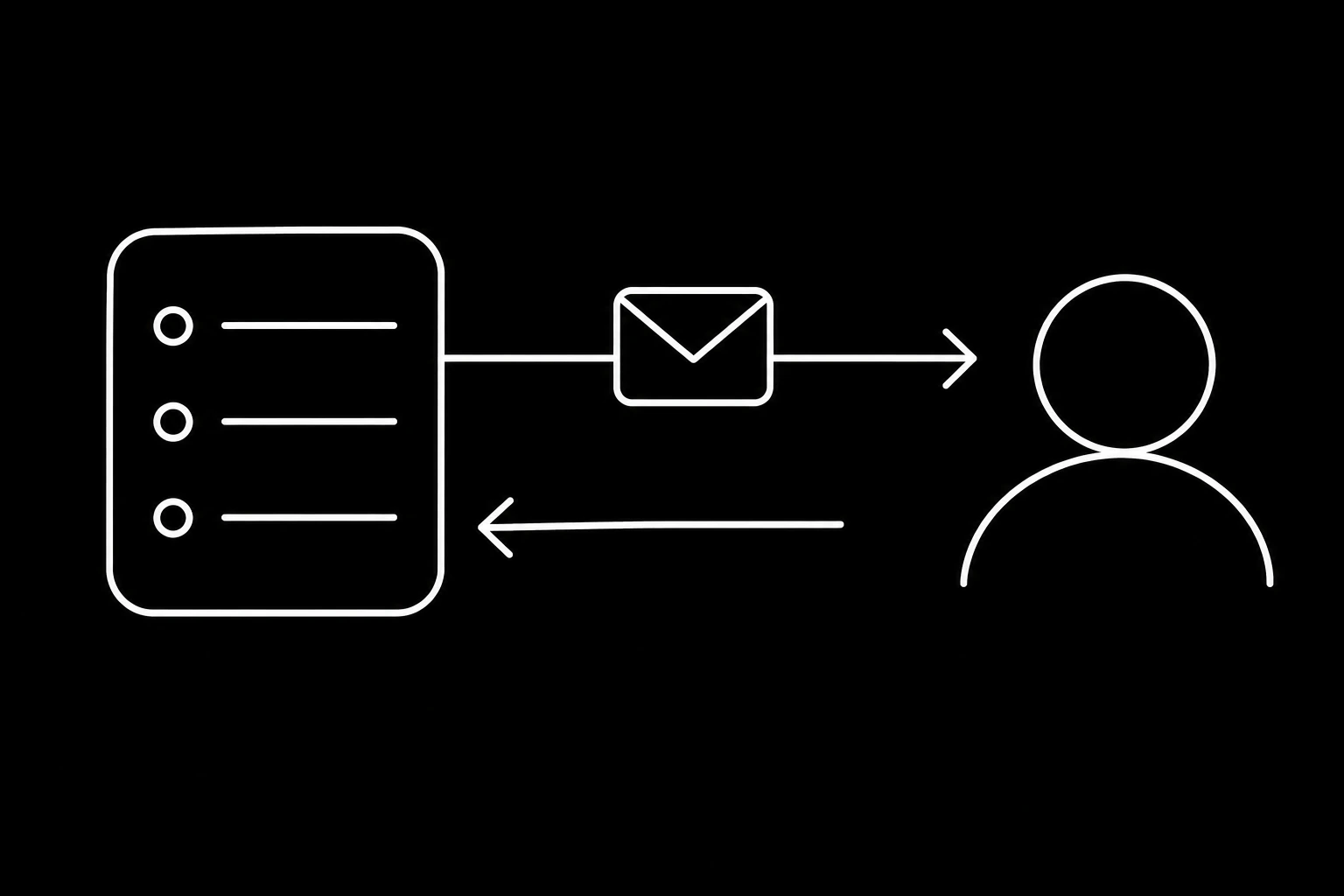
A transactional provider is excellent at the outbound half: authenticated, fast, with delivery events and good reputation management. Nothing here argues against that, and if all you do is send receipts, you are done.
What none of them are built for is the return path, because a receipt does not expect an answer. Once an agent has to hold a conversation you need a set of things that are not on the sending side of the product, per transactional, marketing, conversational.
| You have | You now need |
|---|---|
| Send API | An inbox with a real address |
| Delivery webhooks | Inbound message webhooks |
| Message ids | Threads assembled from References |
| Templates | Quoted history stripped for a model |
| Suppression on bounce | Suppression plus per-agent scope |
| One API key | A key per agent identity |
| Logs | A readable audit trail per identity |
The parts people underestimate
Threading. Reassembling a conversation from In-Reply-To and References, deduplicating, ordering, and stripping quoted history so a model is not paying for the same text six times. Every team that builds this does it twice, because the first version handles the happy path, per how email threading actually works.
Waiting. An agent that asks a question needs to know when the answer arrives, without a scheduler polling a mailbox. That is a server-side wait, and building it yourself means a queue, a timer, and a resume path, per long-running email conversations.
Memory. Contact records that accumulate across conversations, so the second exchange with someone starts informed. Not a mail feature at all, which is why it usually ends up half-built in a database nobody maintains.
Scope. One key per agent rather than one key per account, so five agents do not share one credential and one audit trail, per keys, scope, and what to do the day one leaks.
None of this is impossible. It is a few weeks of work, and then it is maintenance forever, which is the trade to make deliberately rather than by accident.
Three ways to combine them
Keep sending where it is, receive separately. Common as a first step and the worst long-term shape, because your outbound and inbound are on different domains and different reputations, so a reply does not thread with the message it answers.
Move conversational mail, leave transactional where it is. The one that usually makes sense. Receipts, password resets, and notifications stay on your existing provider. Anything an agent sends or answers moves, on its own agents subdomain. Two lanes, cleanly separated, per deliverability for agent senders.
Move everything. Simplest mentally, and rarely worth the migration for mail that is working fine and never gets a reply.
The middle option is what most teams land on, and the split is not a compromise: transactional and conversational genuinely want different infrastructure.

Doing it without a cutover
- Add an agents subdomain and verify its records. Nothing else changes yet, per SPF, DKIM, and DMARC for an agent subdomain.
- Point one narrow conversational flow at the agent, forwarded rather than redirected.
- Leave every transactional message exactly where it is.
- Watch a week of threads before moving anything else.
- Move the next conversational flow, and repeat.
Your existing provider keeps doing the job it is good at throughout, and if the agent turns out to be wrong for a category, you stop forwarding and nothing broke.
Where the comparisons live
If you want the feature-level view against what you are running now, the comparison pages cover it: Resend, Postmark, SendGrid, and Mailgun. The short version is that they are sending products with varying amounts of inbound bolted on, and this is an inbox product that also sends.
Which is better depends entirely on whether your mail expects an answer.
Questions
- Can I use my existing email provider for an AI agent?
- For sending, yes. The gap is the return path: an inbox, threading, waiting for replies, contact memory, and per-agent scope, none of which are sending features.
- Should I move all my email?
- Usually not. Keep receipts and notifications where they are, and move the conversational mail an agent sends or answers onto its own subdomain.
- What is hardest to build yourself?
- Threading and the server-side wait. Threading looks simple until forwards, top-posting, and quoted history arrive, and waiting means a queue, timers, and a resume path.
- Why not just poll the mailbox?
- Latency and wasted requests, plus you then own the state that the thread already holds. Webhooks plus a blocking wait is both cheaper and simpler.
- Does splitting across two providers hurt deliverability?
- Not if each lane has its own subdomain with its own authentication. It hurts when outbound and inbound live on different domains, so replies do not thread with what they answer.
- How do I migrate without a cutover?
- Add the agents subdomain, forward one conversational flow, leave transactional untouched, read a week of threads, then repeat. Every step reverses in one click.
Give your agent an address it can answer from.
Create an inbox